

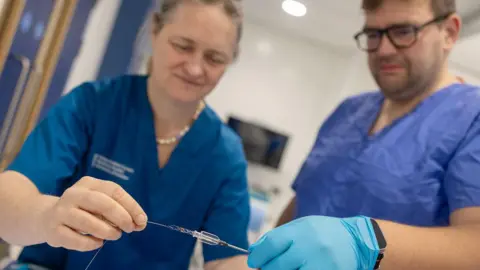
Doctors from Scotland and America have successfully completed what is thought of as a pioneering stroke procedure employing automated systems.
Prof Iris Grunwald, associated with a Scottish university, conducted the remote thrombectomy - the elimination of circulatory obstructions after a cerebral event - on a medical specimen that had been donated to medical science.
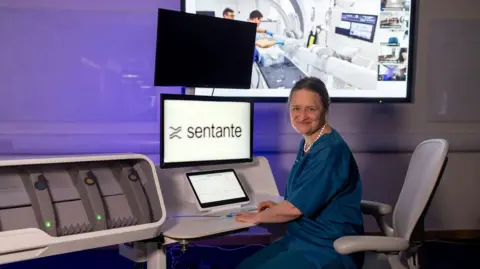
The professor was working from a treatment center in the Scottish city, while the subject undergoing procedure while using the system was at another location at the university.
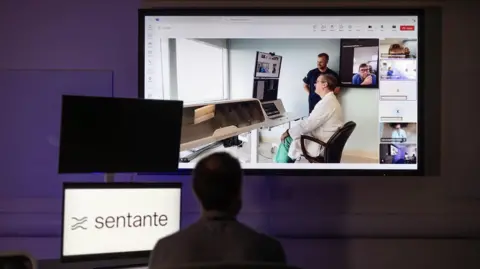
Subsequently, a medical specialist from Florida employed the technology to perform the pioneering long-distance operation from his Florida location on a human body in the Scottish city over 4,000 miles away.
The research collective has called it a potential "revolutionary development" if it becomes approved for use on patients.
The medics think this innovation could change cerebral healthcare, as a delay in accessing specialist treatment can have a major influence on the chances of recovery.
"It felt as if we were seeing the first glimpse of the future," stated Prof Grunwald.
"Whereas before this was considered theoretical concept, we showed that all stages of the surgery can currently be accomplished."
The medical research center is the worldwide teaching facility of the World Federation for Interventional Stroke Treatment, and is the sole location in the United Kingdom where surgeons can work with cadavers with actual blood flowing through the vessels to simulate procedures on a actual patient.
"This represented the pioneering moment that we could execute the entire surgical process in a real human body to show that each stage of the surgery are feasible," explained the lead expert.
Juliet Bouverie, the director of a health foundation, called the intercontinental surgery as "an extraordinary advancement".
"For too long, individuals from remote and rural areas have been denied availability to surgical intervention," she stated.
"This type of automation could rebalance the inequity which occurs in stroke treatment nationwide."
How does the system function?
An blockage stroke happens when an blood vessel is obstructed by a blockage.
This disrupts blood and oxygen supply to the neural matter, and brain cells stop functioning and expire.
The superior intervention is a thrombectomy, where a expert uses surgical tools to extract the blockage.
But what occurs when a patient is unable to reach a expert who can perform the surgery?
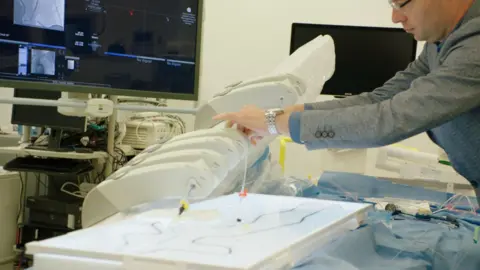
Prof Grunwald explained the experiment demonstrated a mechanical device could be attached to the same catheters and wires a doctor would conventionally utilize, and a healthcare professional who is present with the individual could readily join the wires.
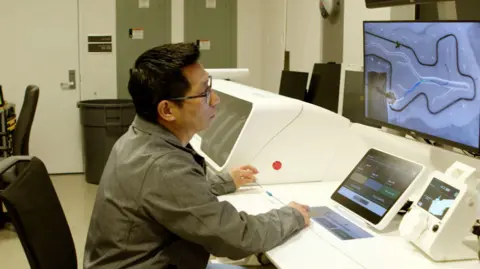
The surgeon, in another location, could then operate and direct their individual tools, and the robot then executes precisely identical actions in real time on the patient to carry out the clot removal.
The individual would be in a treatment center, while the specialist could conduct the surgery via the automated equipment from anywhere - even their private dwelling.
The medical expert and the neurosurgeon could observe real-time imaging of the specimen in the experiments, and track developments in live conditions, with the Scottish specialist saying it took merely twenty minutes of preparation.
Major corporations prominent manufacturers were contributed to the research to guarantee the network connection of the robot.
"To conduct procedures from the US to Scotland with a 120 millisecond lag - an instant - is absolutely amazing," commented Dr Hanel.
Advancements in brain care
The medical expert, who has been honored for her work and is also the executive member of the global healthcare association, explained there were key issues with a standard thrombectomy - a worldwide deficiency of surgeons who can perform it, and treatment depends on your physical place.
In the region, there are only three places people can receive the procedure - urban centers. If you aren't located nearby, you must journey.
"The treatment is extremely time-critical," said the lead researcher.
"For every six minutes of waiting, you have a one percent reduced probability of having a positive result.
"This innovation would now offer a novel approach where you're not depending on where you dwell - conserving the precious time where your neural tissue is deteriorating."
Public health data showed there were {9,625 ischaemic strokes|numerous cerebral events|


